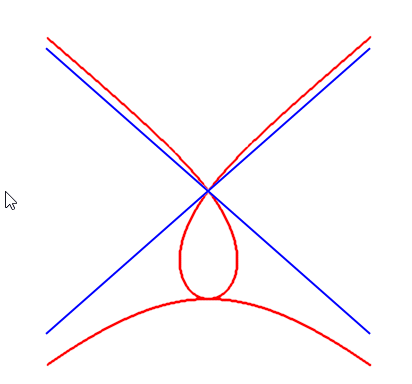
k < 1
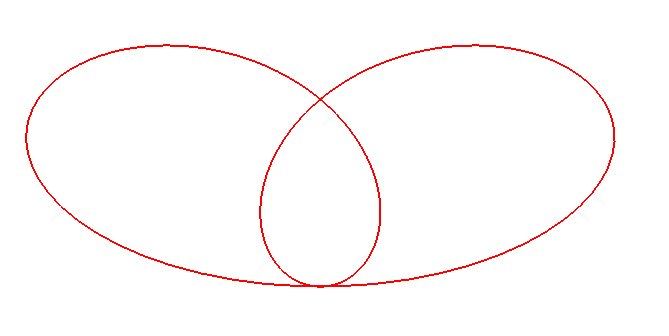
k > 1
| Next curve | previous curve | 2D curves | 3D curves | Surfaces | Fractals | Polyhedra |
CAPRICORNOID
|
k < 1 |
k > 1 |
| Curve studied by Poncelet in 1862 (applications
d'analyse et de géométrie, p. 460)
Name given by Poncelet by analogy with horns of goat (capra in Latin). Ref : Loria page 244 and 788. |
Cartesian parametrization: 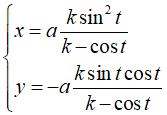
Polar equation: 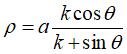 where  . Cartesian equation:  . Circularrational quartic. |
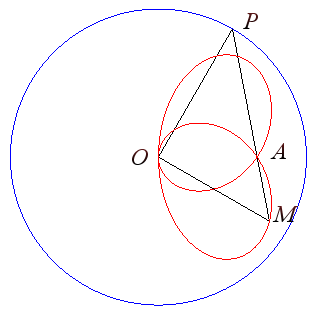
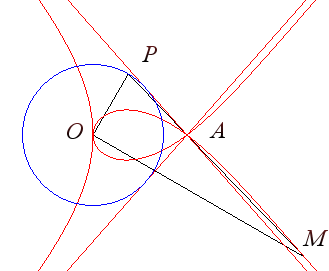
Given a fixed point A(a, 0) and a circle
(C) of center O and radius ka, the capricornoid  is the place of the end
M from a right angle POM, the point
P
describing the circle (C), and the point M belonging to the
line (AP). Note: if we exchange the roles of A and O, we obtain the curve of Jerabek, which has a similar shape for k > 1. The transformation |
|
|
|
When A is inside the circle (k > 1), the curve is closed, included in the circle, and has a double crunodal point (A) and a double tacnodal point (O).
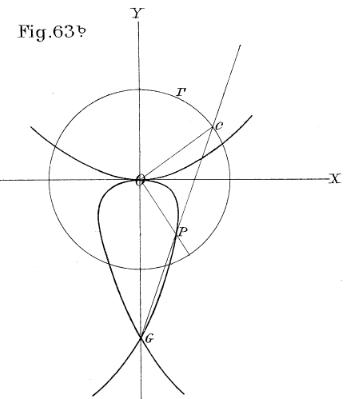
When A is on the circle (k = 1), we Gets
the right trophoid
: 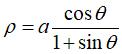 (construction
by Pierre Apel).
When A is outside (k < 1), there is a
double crunodal point and a double tacnodal point, and two asymptotes.
| Next curve | previous curve | 2D curves | 3D curves | Surfaces | Fractals | Polyhedra |
Robert FERRÉOL © 2026
 is an involution by construction. Analytically defined by
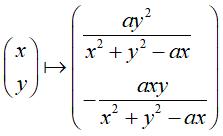 ,
it is a quadratic transformation like the
