BICYLINDRICAL CURVE
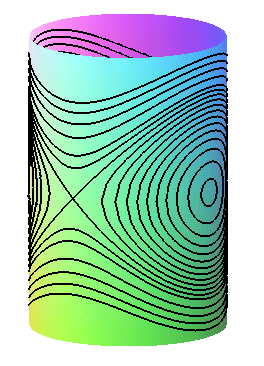
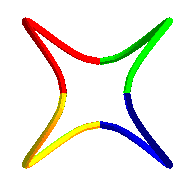
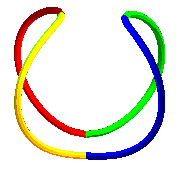
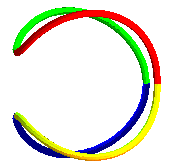
The bicylindrical curves are the intersections between
two cylinders
of revolution.
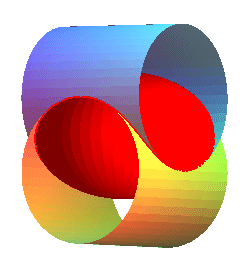
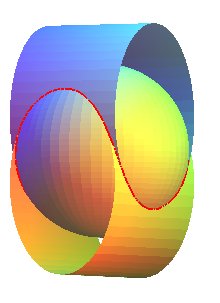
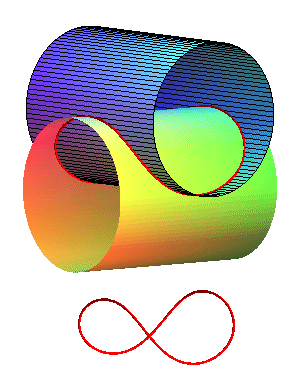
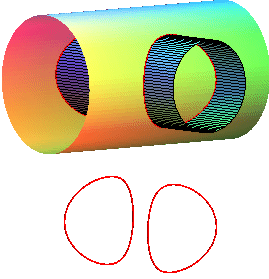
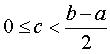
First case : two orthogonal cylinders with radii a
and b, and axis at distance 2c.
System of Cartesian equations: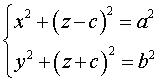 . .
Biquadratic.
Cartesian parametrization: 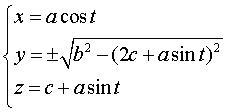 . .
Cartesian equation of the projection on xOy:  (see the Alain curve).
Area of the portion of cylinder delimited by each component,
for  and
c
= 0,
given by an elliptic integral of the second kind: and
c
= 0,
given by an elliptic integral of the second kind:  ,
that reduces to 4a2
when a = b. ,
that reduces to 4a2
when a = b. |
Case a = b:
The curve is invariant under the two half-turns
that swap the two cylinders.
Case a < b:
One can notice that the bicylindrical curve is traced
on the ellipsoid  . .
By scaling, we can turn the ellipsoid into a sphere,
while the two cylinders become elliptic cylinders. The intersection obtained
is one of the possible seam lines of
a tennis ball. |
 |
 |
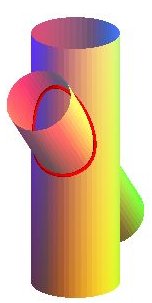
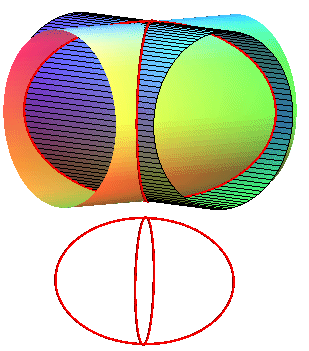
Second case : two cylinders with secant axes, one of radius
a,
the other of radius b, forming an angle  with the plane orthogonal to the first.
System of Cartesian equations: 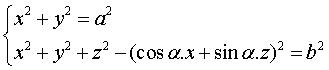 . .
Cartesian parametrization: 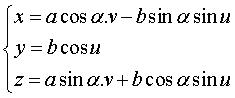 ,
where ,
where 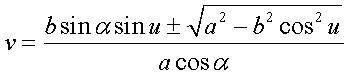 . .
Case a = b : 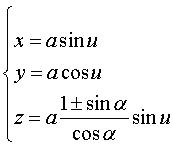 ,
union of two ellipses. ,
union of two ellipses. |
|
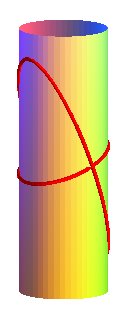 Case a = b
 |
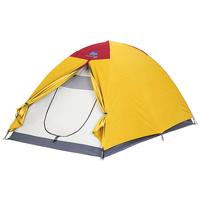
|
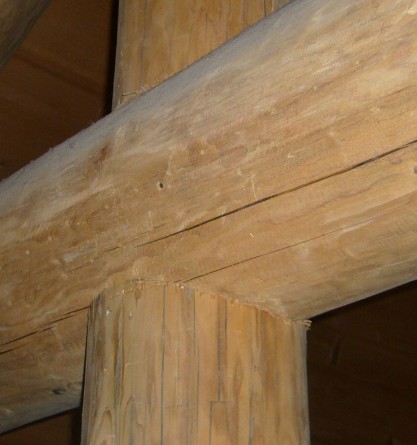
Beams of my chalet...
|

Botzaris station, in the Parisian Metro.
|

Lights in my staircase
|
Many other examples on the mathourist's
page!
© Robert FERRÉOL
2022
 that intersect at their secondary vertices with a right angle.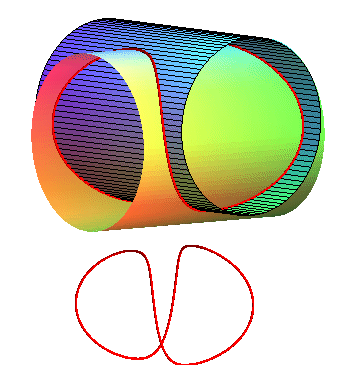
 (here
c
= 0): curve with two components.
(here
c
= 0): curve with two components.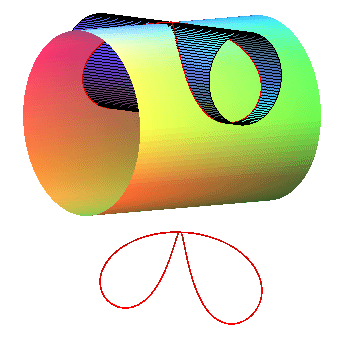
 :
figure-eight curve similar to the
:
figure-eight curve similar to the 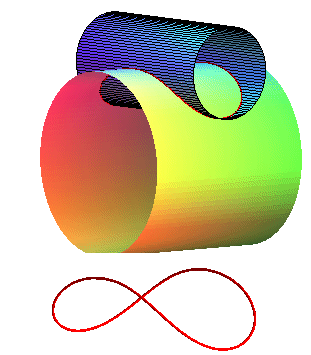
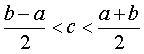 :
curve with one component.
:
curve with one component.