CURVE OF CONSTANT PRECESSION
| next curve | previous curve | 2D curves | 3D curves | surfaces | fractals | polyhedra |
CURVE OF CONSTANT PRECESSION
| Curve studied by R. Hoppe in 1861 and by Paul D. Scofield in 1995. |
Cartesian parametrization: 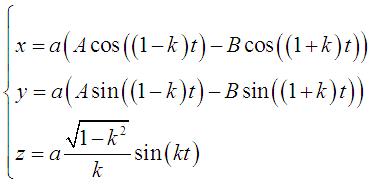 where
where 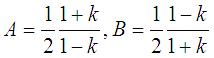 . .
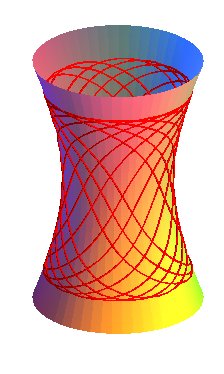
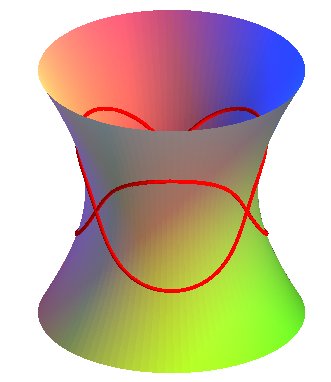
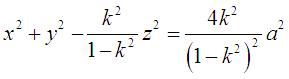
Curve traced on the hyperboloid: |
The curves of constant precession are the curves such that the instant rotation vector of the Frenet frame has a motion of uniform rotation around a fixed axis when this frame travels along the curve at constant speed. Therefore, this vector has a motion similar to that of the axis of a spinning top, hence the expression "constant precession".
Remember that if the Frenet frame is written  ,
then the instant rotation vector
,
then the instant rotation vector  is defined by the relations:
  and given by the formula:
 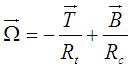 .
.
The projection on the plane xOy of the curve given
above is an epitrochoid
with parameter  . .
Opposite, the case k =3/5 which gives q
= 3.
|
 |
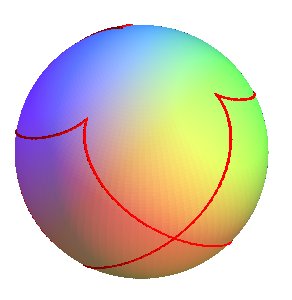
The end of the tangent vector describes the spherical
indicatrix of curvature of the curve; the formulas 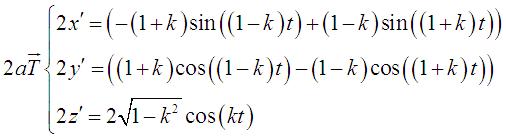
show that this indicatrix is a spherical helix. Opposite, the indicatrix of curvature of the curve above. |
 |
Compare to the Capareda
curves.
| next curve | previous curve | 2D curves | 3D curves | surfaces | fractals | polyhedra |
© Robert FERRÉOL 2018
 .
.
 .
.
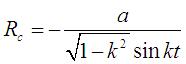 ,
radius of torsion:
,
radius of torsion: 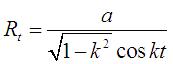 .
.
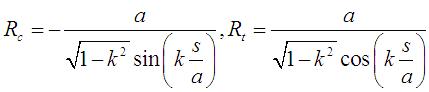 .
.
 .
.